Natural Church Development Principles: Symbiosis

The Preacher says: “Pride leads to disgrace, but with humility comes wisdom.” (Proverbs 11:2 NLT)

The ancient Greeks believed this, and so did the Preacher. Stephen Covey says that pride is the great barrier to Synergy or symbiosis. He gives this example: “The synergy mentality short-circuits conflict in the workplace, and the resulting spark of genius can be dazzling. But synergy does not come cheap, and the forces working against it are formidable. The toughest barrier to synergy is pride. It’s the great insulator that prevents the creative blending of human energies.

There is a whole continuum of pride, from the familiar “NIH Syndrome” (“If it’s Not Invented Here, it can’t be worth anything”) all the way to the hubris that leads to the downfall of people, organizations, and nations.

The ancient Greeks taught that hubris, or extreme arrogance, was the worst of crimes. In those days, a soldier who boasted of his own strength and humiliated his enemies was guilty of hubris. So was a king who abused his subjects for his personal gain. The Greeks believed that hubris would bring on nemesis, or inevitable ruin. Hubris, they said, always leads to tragedy in the end—and they were right.

Today we’ve seen the collapse of some of our most trusted institutions because of hubris at the highest levels. In the financial debacle of 2008, many key leaders were guilty of everything from blind overconfidence to outright fraud.

The main symptom of hubris is a lack of conflict. If no one dares to challenge you, if you receive little input from others, if you find yourself talking more than listening, if you’re too busy to deal with those who disagree then you’re heading for a fall. An example is the former head of the Royal Bank of Scotland.

According to reports, this man “brooked no criticism. . . . Every morning his immediate circle took part in a meeting where on occasions executives could he reprimanded seriously.” He referred to his unfriendly acquisitions as mercy killings. The Times of London called his leadership “hubristic.” Thus he was isolated from the truth about the oncoming banking crisis, for which his aggressively risky business dealings were said to be partly responsible

In 2007 his bank was worth £75 billion; by 2009 it was worth £4.5 billion and had suffered “the biggest loss in British banking history.”’

Looking at another example, it’s probable that the anti-synergy mind-set at Enron brought that company down. Observers see in Enron the classic model of a hubristic culture: “This was a company that purposely shut down alternative and conflicting views of reality to protect the status quo. In the name of preserving success and being in hard-nosed pursuit of greatness, an inflexible, intolerant culture developed in which new ideas were ignored, concerns were dismissed, and critical thinking got you fired.” (Covey, ‘The 3rd Alternative’)

The Preacher was so convinced of the folly of pride that he states categorically that it leads to disgrace, period. And he states it publicly as an axiom, a life principle, as though there is no escaping the disgrace that pride will bring in the end. Pride makes us think we’re better than we are. Pride prevents us from listening to the opinions of others as being valid perspectives in any given situation. Pride makes us think we know best. Pride prevents us from understanding that we, too, have blind spots, and that we need others to help us understand the whole picture.
Change and Natural Church Development

The church is just over twenty years old. It’s a suburban church. It was planted with the intention of providing a worship experience that would appeal to the unchurched of the suburb. One might suppose that would be the purpose of every church, but that doesn’t seem to be the case.

The pastors – a married couple – and their team worked well together. The church was established and built around the gifting of the pastors. It reached a peak attendance of just over 250 in the Sunday morning service.

Since the founding pastors moved on eight years ago, there have been three changes of pastor couples (with another taking up the challenge early 2017).

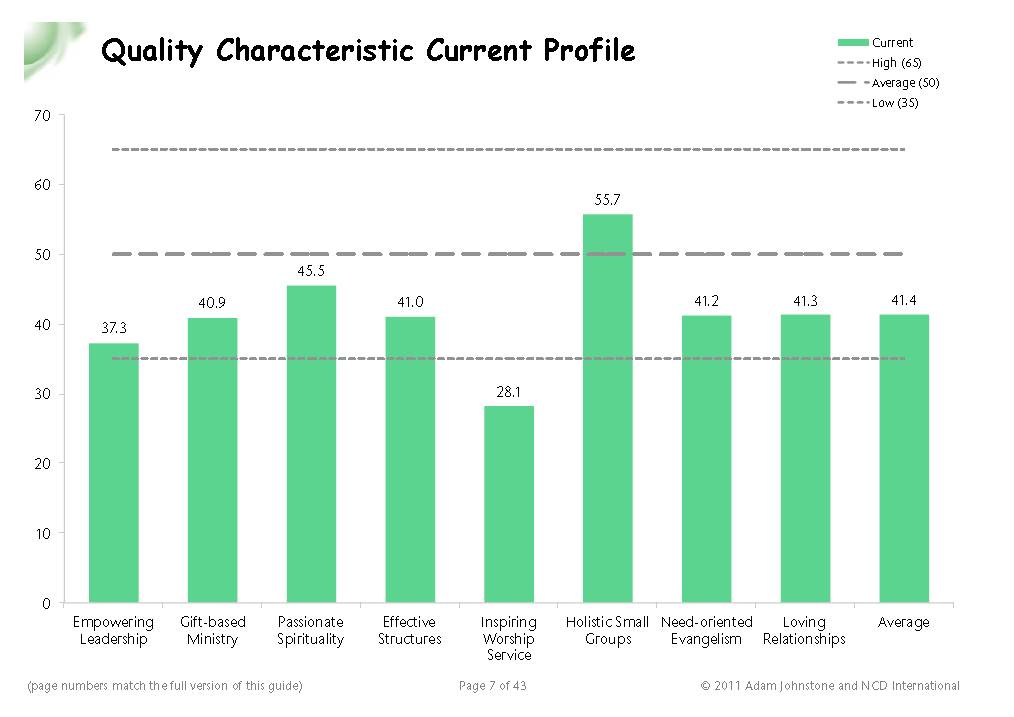
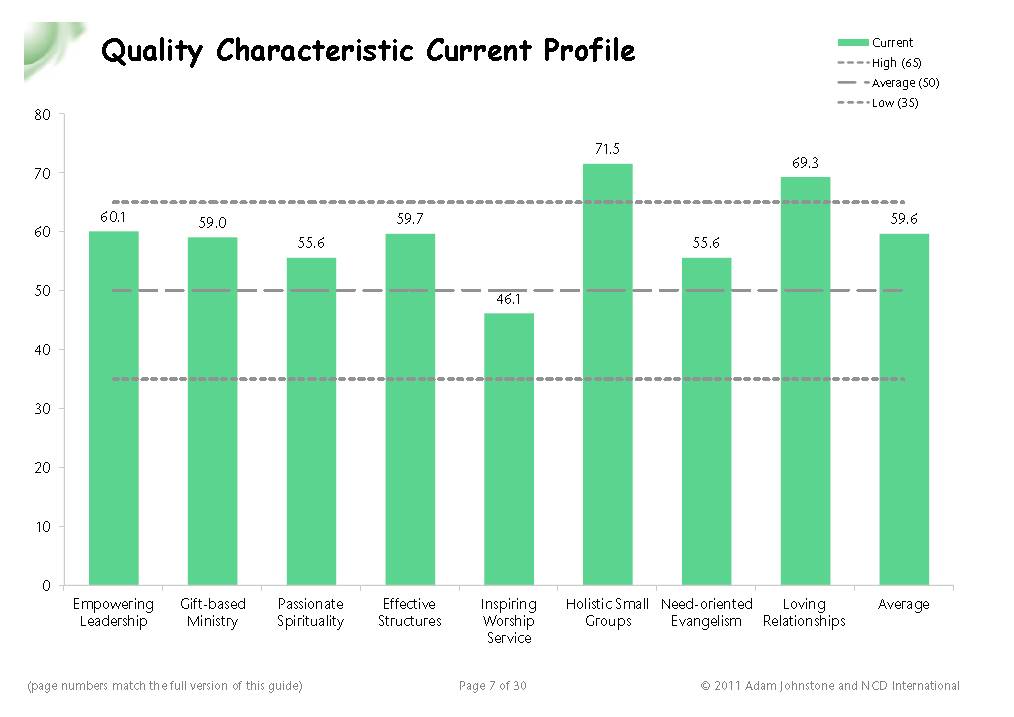
The last two sets of pastor were there for three years each – the last six years. And it was six years ago the church decided to engage with the Natural Church Development health assessment. They were somewhat disappointed to get this result:

Taken by itself, this is an encouraging result. But this church and the pastors were disappointed. They were especially disappointed because the church had a reputation for great worship. They were also disappointed because the pastor’s previous church had been healthier.

Five years, five surveys and a change of pastors, and all their efforts, and not much else has changed (although the level of frustration has risen!).

All six surveys have shown the same pattern – Minimum Factor: Inspiring Worship Service. Maximum Factor: Holistic Small Groups. Visitors to this church love the worship; why have the most influential lay people responded to the NCD health test so that it consistently showed this result?

At the beginning this church demonstrated so much promise.

What might be the trouble?

The “Natural” in Natural Church Development

One of the masters, C.S.Lewis, considers the meaning of the word. This is from his book, ‘Miracles.’

“I begin by considering the following sentences. (1) Are those his natural teeth or a set? (2) The dog in his natural state is covered with fleas. (3) I love to get away from tilled lands and metaled roads and be alone with Nature. (4) Do be natural. Why are you so affected? (5) It may have been wrong to kiss her but it was very natural

A common thread of meaning in all these usages can easily be discovered. The natural teeth are those which grow in the mouth; we do not have to design them, make them, or fit them. The dog’s natural state is the one he will be in if no one takes soap and water and prevents it. The countryside where Nature reigns supreme is the one where soil, weather, and vegetation produce their results unhelped and unimpeded by man. Natural behaviour is the behaviour which people would exhibit if they were not at the pains to alter it. The natural kiss is the kiss which will be given if moral or prudential considerations do not intervene. In all the examples Nature means what happens ‘of itself’ or ‘of its own accord’: what you do not need to labour for; what you will get if you take no measures to stop it. The Greek word for Nature (Physis) is connected with the Greek verb for ‘to grow’; Latin Natura, with the verb ‘to be born’. The Natural is what springs up, or comes forth, or arrives, or goes on, of its own accord: the given, what is there already: the spontaneous, the unintended, the unsolicited.” (‘Miracles’ by CS Lewis, p.16)

The NCD Process: Commitment

Why do church leaders do one or two or even more church health surveys, and then quit?

Why do they not commit to the process, and follow through to becoming a healthy church?

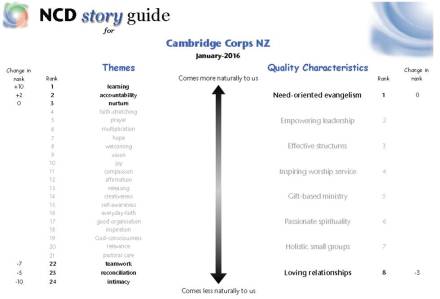
Perhaps the answer is hinted at, in part, in the front page of the NCD Story Guide (see picture):Story Guide

Notice how the results are set out. There is a column with common church Themes and another showing a list of the eight Quality Characteristics, in a different order than we may be accustomed to seeing them. Both of these columns run from strongest to weakest. The bold line in the centre has the caption at the top, ‘Comes more naturally to us,’ and at the bottom, ‘Comes less naturally to us.’

Changing a church culture in order to address weaknesses (read ‘health issues’) is no easy road. Changing oneself is difficult enough, yet that has to be the place where one begins.

There is no suggestion here that NCD is suggesting that we should ‘play to our weaknesses.’ When we think of ‘teams’ and ‘talents’ and ‘spiritual gifts’ each person must play to their strengths. They should focus on those things that ‘come more naturally’ to them; and the same applies to a church. When it comes to character issues, the fruit of the Spirit, or health, we cannot rely on others to compensate for our deficiency.

If the survey result reveals that a church’s strength (something that comes naturally to the church) is Need-oriented Evangelism, and church leaders are somewhat bemused at the lack of newcomers turning up, perhaps a closer look at those things that ‘come less easily to us’ – the Minimum Factors – might just give a clue. As will be very clear, Need-oriented Evangelism is never going to work as it should in the church represented by the diagram above without real attention being given to Loving Relationships. Jesus made that very clear.

Christian Schwarz (Founder and Director of NCD International) has demonstrated the eight Quality Characteristics to be interdependent. If one is weak, without appropriate attention being given to it, it will drag the others down. The church will continue to limp along (like an unhealthy person going about their business) only a fraction of what it could be, not measuring up to what God has in mind for it.

Perhaps church leaders are not committed to the NCD process of becoming healthy; they did a survey out of curiosity and they are finding the changes required to improve church health are just too difficult for them. So they have decided to ignore the survey result and go back to what they were doing before.

If your church fits into this category, let me encourage you to pick it up again; this time, really commit to the process. Follow through. Of course, if you do that you may have to lead the change that is required. As someone once said, “Be the change you want to see.”

Natural Church Development and Process

Allow ‘. . . yourself to win by following the process rather than being caught up in outcomes.’ (‘Legacy,’ What the All Blacks can teach us, p.105, James Kerr). This may have been written about the ‘business’ of life but it applies equally well to the church!

Is this what our church is like?
Do we know what outcomes our church is looking for?
Are we following a clear process to achieve those outcomes?

Natural Church Development says if we have a healthy church, growth (all kinds of growth – people, leaders, financial) will happen automatically – ‘all by itself’ (see the book by Christian Schwarz, ‘The All By Itself Pathway’).
The processes to follow in a church are those that result in a healthy church. That means we need to be aware of four things.

We need to know:
1     What a healthy church looks like (our goal)
2     Our church’s current state of health
3     What we need to do progress from where we are to where we want to be
4     We need to do it!

Number 1 informs us where we want to be, our destination.
Number 2 informs us where we are now. We cannot get anywhere without knowing where we are starting from!
Number 3 gives us the process we should follow to get from #2 to #1.
Number 4 is totally practical; we must follow the process.

The quotation from ‘Legacy’ continues: ‘. . . most organisations . . . tend to go for the one-off hits, which is unrealistic: a training session, an away day, an inspirational speech, but nothing continuous and progressive. Few focus on long-term development, on a programme of improvement.’

Natural Church Development and Principles

In his Empowerment Diary, entry #127, Christian Schwarz (Founder and Director of NCD International) said: “Today I had an interesting discussion about the question of why we focus so consistently (the person I spoke to called it, “fanatically”) on principles throughout all of our NCD tools (the criticism was, “Not practical enough!”).

The answer is simple:

Principles are valid whether you believe in them or not. They will influence your life, even if you should decide to reject them. They apply regardless of your theological bent, your philosophy of ministry, or your favourite church model. And they even apply should you decide not to utilize them. In other words, whenever we are dealing with provable principles (rather than mere models or inspirational examples), we are on solid ground. Once we have identified the principles (which in our case works in a blend of empirical research and biblical/theological evaluation), the second step is to apply them to complex realities of an individual church – the core of any Mutual Empowerment Process.”

Stephen Covey (7 Habits) says: “I do not agree with the popular success literature that says self-esteem is primarily a matter of mind-set, of attitude – that you can psyche yourself into peace of mind. Peace of mind comes when your life is in harmony with true principles and values and in no other way.”

One such principle (and how they work) is referred to in a paper published at Harvard Business School where Michael C. Jensen, Werner Erhard and Steve Saffron explore the relationship between integrity and performance. Of integrity, they say: “Like the law of gravity, the law (principle) of integrity just is, and if you violate the law of integrity . . . you get hurt just as if you try to violate the law of gravity with no safety device.” (‘Legacy’ James Kerr, page 127)

Integrity is one of the principles that is unchanging and unchangeable. No one can ignore or ‘break’ the integrity principle without being seriously damaged themselves.

And integrity is just one of them!

People may accomplish remarkable things while ignoring these principles, but their work will prove unsustainable in the long run.

Natural Church Development and “Legacy”

This is an appropriate time to recommend a book: “Legacy” by James Kerr. Subtitled, What the All Blacks can teach us about the business of life. It’s an appropriate time because we are in the middle of the 2015 World Rugby Cup in England, and the All Blacks are about to play a quarterfinal against France this coming weekend.
Let me select a very few choice pieces:
After the game, while the country is still watching replays and schoolkids lie in bed dreaming of All Black glory, the senior All Blacks are tidying up after themselves. They have had the debrief; now they have picked up brooms and are sweeping the shed. Doing it properly. They have a servant spirit.
Character before Talent:
Wayne Smith (one of the coaches) said: “Talent was irrelevant.” We used certain game stats that determine the player’s character, and that’s what we were after. We picked high work rate, guys that were unselfish and had a sacrificial mindset. It is the identity of the team that matters – not so much what the All Blacks do, but who they are, what they stand for, and why they exist.
Leadership and Empowerment:
The All Blacks have developed a leadership culture. The structure of the working week: The Sunday evening review meetings are facilitated by the coaches, thought significant input comes from the on-field leadership. Then over the course of the week, you see a gradual handing over of responsibility and decision-making. By Thursday, the priorities, intensity levels and other aspects are all ‘owned’ by the players. By the time they play on Saturday the players have taken over the asylum. Graham Henry (head coach at the time) says that enabling his players to take charge of their own environment is, of all his achievements in rugby, the thing of which he is most proud.
What would the church look like if pastors operated this way?
If you are able to make the connection, this is a great book on discipleship and leadership. It fits very well into the principles of Natural Church Development. I do not hesitate to recommend it.

Natural Church Development: A Question

Why are only 30 people required to fill in questionnaires in order to complete the Natural Church Development church healthy survey?

Why don’t we survey the whole church? Wouldn’t that be more accurate? And what if the church has 300 members? Or even 3000 members? Do we still need just 30 to obtain an accurate health assessment?

NCD International says we need just 30 people; but those 30 should meet certain requirements:

(1) They should have a ministry of some kind in the church, even if just a small one.

(2) They should be a member of a small group. Christian Schwarz defines a small group as a ‘group that is small!’ That is, a small group is a prayer or Bible study group, the music or worship team, the choir, the leadership team, the pastoral care team, the fund-raising task force, the men’s or women’s group, or any committee. A small group is a few people in the church who meet on a regular basis. And after these two criteria:

(3) They should be representative of the demographics of the church.

By means of this survey we are trying to assess the ‘spiritual’ health of the most influential people in the church; we want to discover their thinking (head); their behaviour (hands); and their feelings (heart) with regard to their relationship to God through our church.

If there are people who are not in a small group, who do not have a ministry, should they be included simple because they are influential? The answer is no! If they are that influential they will influence those who do meet the criteria. Disconnected from formal church involvement, even though people of influence, such members will be unable to give answers to questions relating to ministry or small groups.

The survey is not designed to capture to opinions of fringe people. A glance at some of the questions would confirm this; they would not know how to answer.. We want to know how the most influential people in the church perceive such matters as: Do the pastors have too much work today? When it comes to ministry, do the people who serve fit; or are they like square pegs in round holes? We do not want the absolute truth on these matters; only God knows that. We want to know how the responsible people in the church perceive it; because for we human beings, perception is the reality.

And just in case you still think we should survey the whole church, think in terms of a blood test (this is, after all, a church health survey). You do not have to give all your blood. The medical experts can glean a great deal of information from just a small sample.

Natural Church Development: Overworked Leaders

When pastors and church leaders are asked if they would like to consider ‘doing NCD,’ they often respond they just don’t have the time for anything more. They are already stretched to the limit. ‘One more thing’ may be the last straw for them and their team. Whenever I hear this, I think of the comment made by a school principal:

“This is not ‘one more thing’ we have to do. This is a better way of doing what we already do!”

He was referring to the principle-based approach to education as demonstrated by a school named A.B. Coombs (see the website for videos of some of those schools http://www.TheLeaderInMeBook.org).

These principles were not invented by Christian A Schwarz (Founder and Director of NCD International), Stephen Covey or James Collins or any other human being. They are largely common sense. All cultures have discovered them – and then forgotten them, and either disappeared or deteriorated. They apply to all human institutions, including schools, governments, family and the church.

Identifying and incorporating these principles is the very best way of journeying through life and building something sustainable. We are governed by these principles even when we are unconscious of them or do not even know they exist. They apply to all of life just as the law of gravity affects us physically.

Natural Church Development, the principle-based approach to church life, is happening in your church even as you read this. It can help greatly when church leaders know these principles and actively co-operate with them. What are they? Such things as Empowerment, Gift-activation, Passion, Effectiveness, Inspiration, Community, Need-relief and Love.

The question is: Which one requires your attention in your church or organisation right now? What happens if you neglect that critical issue (think about these questions in terms of your own health)?

What is stopping you from taking steps to identify church health issues right now?

Natural Church Development: Effective Structures

In his book, ‘The 8th Habit,’ Stephen Covey reported

“People today are expected to produce more for less in a terribly complex world, yet they are simply not allowed to use a significant portion of their talents and intelligence. In no way is this pain more clearly or practically manifest in organisations than in their inability to focus on and execute their highest priorities.

A poll of 23,000 workers in key areas of industry, by Harris International, found:

Only 37 percent said they have a clear understanding of what their organization is trying to achieve and why.

Only 1 in 5 was enthusiastic about their team’s and organization’s goals.

Only 1 in 5 workers said they have a clear “line of sight” between their tasks and their team’s and organization’s goals.

Only half were satisfied with the work they have accomplished at the end of the week.

Only 1 5 percent felt that their organization fully enables them to execute key goals.

Only 1 5 percent felt they worked in a high-trust environment.

Only 17 percent felt their organization fosters open communication that is respectful of differing opinions and that results in new and better ideas.

Only 10 percent felt that their organization holds people accountable for results.

Only 20 percent fully trusted the organization they work for.

Only 1 3 percent have high-trust, highly cooperative working relationships with other groups or departments.

If, say, a soccer team had these same scores, only four of the eleven players on the field would know which goal is theirs.

Only two of the eleven would care.

Only two of the eleven would know what position they play and know exactly what they are supposed to do.

And all but two players would, in some way, be competing against their own team members rather than the opponent.

The data is sobering. It matches my own experience with people in organizations of every kind all around the world. Despite all our gains in technology, product innovation and world markets, most people are not thriving in the organizations they work for. They are neither fulfilled nor excited. They are frustrated. They are not clear about where the organization is headed or what its highest priorities are. They are bogged down and distracted. Most of all, they don’t feel they can change much. Can you imagine the personal and organizational cost of failing to fully engage the passion, talent and intelligence of the workforce?

It is far greater than all taxes, interest charges and labour costs put together!” (End quote)

There is something special about the church; yet it is still an organisation administered by fallible human beings. It is likely similar research would produce a very similar result. Might this be one of the contributing factors as to why, in spite of every effort we are making, and even with the blessing of God, most churches are not making much headway in the western world today?

Natural Church Development can help us find out a great deal about our own church; and can also help to improve matters – if we care to address what we discover. At least we would all know what our goals were!