Now NCD can help your church: Minimum Factor ID

Natural Church Development has the potential to Identify the Church’s Weaknesses, Obstacles, Opportunities:

How can knowing our weaknesses be of value to us?

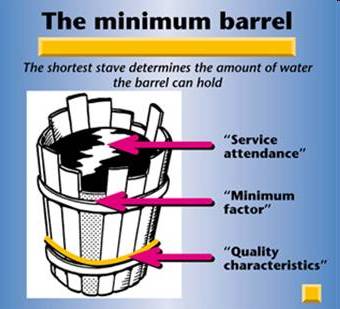
If the NCD survey really is a health test for a church, the Minimum Factor is not simply ‘a weakness’ that we can ignore while we concentrate on ‘playing to our strengths!’ It is difficult—in some cases, impossible—to continue achieving our purpose as a church when we as a church are unwell. Instead, it becomes very important that we give attention to addressing our ’weakness’ in order to become healthy or whole. When we look at what the NCD survey actually measures, we become aware of the inadequacy of ignoring the Minimum Factor and simply   concentrating on our Maximum Factor.
Image

The barrel illustration (above) portrays exactly how such activity totally fails to help. When we focus on the Maximum Factor (the longest stave) and seek to do it even better (make it longer), the church is not helped to advance the mission (the barrel fails to hold any more water. It is only when we identify the specific health issues in our church and take definite steps designed to address them that we may expect, with some degree of confidence the blessing of our God. When we know our weakness and our strengths (as the NCD survey result reveals), we can find ways of using the strengths to address our weakness. When personal health is under fire, our body has mechanisms that automatically send strong healthy cells to fight whatever is threatening. Unfortunately, in these days, the church does not do this automatically; so leaders must have appropriate information to intentionally and deliberately address such issues.
How NCD can help your church: Strengths Identification

Natural Church Development has the potential to Identify the Church’s Strengths!

Some criticize Natural Church Development – even reject it – because of the focus on the Minimum Factor or weakness. They believe we should always focus on our strengths. But a little thought will reveal there are times when we should play to our strengths, and other times when we must give attention to our weakness.

For example, when it comes to spiritual gifts we play to our strengths, but with the fruit of the Spirit we seek to strengthen our weakness.

When we visit the doctor he/she is looking for, even concentrating on, areas of weakness/damage/infection. The doctor is not really that interested in your good knee. When it comes to health, we are all minimum factor people; and the same may well apply to your church.

So why is it helpful to know your church’s strengths?

Consider the human body again: When you are sick your body automatically applies your strengths to compensate for, even heal, your illness. A church, unlike the human body, does not generally address its weakness (sickness) intuitively or automatically – unless it is an exceptional church! Let’s face it. Most churches don’t even know their weaknesses that need to be addressed. Nor do they know the strength they have that may be applied in healing those places that are weak.

Churches need an intentional strategy to use their strengths to improve their health.

In a church where Inspiring Worship Service is the Minimum Factor (weakness, sickness) and Holistic Small Groups the Maximum Factor (strength, area of good health), leaders should address the question:

How can our church use Holistic Small Groups to improve Inspiring Worship Service?

Another message of good news from NCD is this: Every church has its strengths; no matter how sick a church may be; no matter how small the church; no matter how unfriendly the church’s environment……every church has strengths to celebrate…….and the NCD survey can be extremely useful in helping us discern the strengths in our church that we should celebrate and use.

“Let us speak, thought we should all our faults and weaknesses – for it is a sign of strength to be weak, to know it, and out with it.” Herman Melville

How NCD can help your church: Right Choices!

Natural Church Development has the potential to Assist Leaders to Make Decisions that will Help their Church and not Hurt it!

Is it possible for leaders, doing something good, to unknowingly damage their church? That’s a big question. What leader would want to harm their church? But some—maybe many—are unwittingly making their own church sick! When leaders pour resources into the wrong area FOR THEIR CHURCH, they run the risk of doing serious damage (my personal conviction is that most churches in New Zealand are in this state and have been for some time)! Why are the many good things promoted by leaders so ineffective? They are doing good things, but the timing is wrong. What happens when we do the right thing at the wrong time? It is counter-productive. It works against us, that’s what happens!

Consider: Why do leaders use a given programme in their church? Why do they pursue any given course of ministry? There are a number of reasons. The course of action was advertised at a conference; or a pastor friend used it with some success; or they came across it on the internet and it looked to be exactly what they wanted.

I suggest these are not good reasons for embracing any course of action in a church.

But isn’t the indiscriminate use of NCD falling into the trap of possibly doing the right thing at the wrong time? Christian Schwarz says there is just one time the NCD survey should not be used; and that is when there is division in the church. In such a situation the first requirement is reconciliation.

Furthermore, NCD should be considered in terms of process, not programme; we must think principle, not programme; we think health and allow growth to take care of itself.

NCD can prevent such a situation from happening by simply identifying the area that should be addressed at this point in the church’s history.

We go to the doctor. The doctor runs some tests, asks some questions, and may then give us a prescription which is specific to us. We are warned against taking other people’s prescription medicine, yet churches do this all the time. Using the NCD survey is like taking your church to the doctor for a medical check-up. The survey result will give you a very accurate diagnosis of the health of your church.

Prescriptive planning just became easier.

How NCD can help your church: Resourcing!

Natural Church Development has the potential to Channel Limited Resources to where they will be Most Effective

Church leaders usually want more! They want more people, leaders, money, space, time, training; church leaders want all these things, but they usually want less work! Natural Church Development can help in all of these areas simply by channelling limited resources to where they will be most effective!

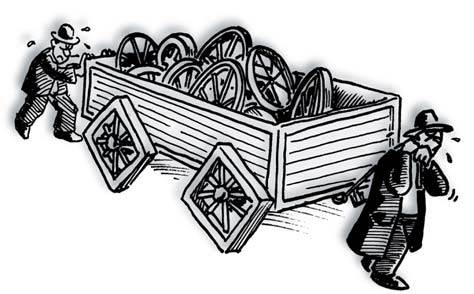
Too often church is like this diagram:

Image

Very often the work is done by a few overworked and exhausted people, while the rest seem to be along for the ride! The good news is that a church does not have to do everything all at once in order to become healthy. If you address the right thing, the Minimum Factor, you will find God has given your church all it needs to do His will.

How NCD can help your Church: Unity

Natural Church Development has the Potential to Unite your Church:

In His high priestly prayer, Jesus prayed that all of His people ‘may be brought to complete unity to let the world know that you sent me and have loved them even as you have loved me.’ (John 17:23).

Note the results that come from complete unity: (1) The world may know that God sent His Son. (2) The world may know that God loves it as much as he loves His Son. From this prayer we may safely assume that unity is pretty important.

In the ancient song expressed in Psalm 133, the writer says: ‘How good and pleasant it is when brothers live together in unity!….For there the Lord bestows his blessing…’ I like the way it comes out in the New Living Translation: ‘How wonderful and pleasant it is when brothers live together in harmony!’

Unity is a good word. But you can have unity using standover tactics – unity by oppression. Unity with ‘yes’ men; unity where the one at the top does all the thinking and the followers simply snap to attention. But harmony , as in the NLT, suggests that people are singing different notes, and yet they are all singing from the same song sheet. Harmony suggests different people, each using his or her different gifts, yet with the same focus. Unity in diversity.

People do have honest differences over doctrine. They have different opinions about style and philosophy of ministry and the kind of music that should be used in a church. But Natural Church Development goes deeper than all of that.

Because NCD can help a church to focus, it can also help unify a church around a common objective: to become a healthy (or even healthier) church.

How NCD can help your church: Focus!

Natural Church Development has the potential to Focus your Church

Do you know the number one thing that stops people from getting what they want? It’s lack of focus! Could it be this is also true of churches? With so much to be done, the temptation for a church is to attempt too much. Jesus was focused. Several of His statements would support this. He said, “I will build my church!” Paul was focused. He said, “This one thing I do!” The old comment, “These forty things I dabble in” is, unfortunately, all too true of so many churches. There are many small churches in the world. Not that there is anything wrong with a church being small – unless God wants it bigger! Perhaps they remain small simply because they are attempting to address far more issues than is possible for them to cope with. Natural Church Development can be especially helpful in this regard for the small to middle-sized church. With limited resources—personnel and finance—it is vital that such churches are able to channel those resources where they will make the most difference. By identifying one out of eight primary virtues as a focus, Natural Church Development helps a church attend to the one vital issue at that time in the church’s journey.

“The indispensable first step to getting the things you want out of life is this: decide what you want.” Ben Stein

How the NCD Survey can help your church: Reality

The Natural Church Development survey reveals, not reality as it is, but reality as the respondents see it.

These are some of the questions from the participants questionnaire: 1. There is a lot of joy and laughter in our church. 2. The atmosphere of our church is strongly influenced by praise and compliments. 3. Our leaders clearly believe that God wants our church to grow. 4. I feel that the worship service has a positive influence on me. 5. It is my impression that the organizational structure of our church hinders church life rather than promotes it. 6. I always look forward to the worship service. 6. I can easily explain why I come to the worship service. 7. Many people are given the opportunity to actively participate in our worship services. 8. The music in the worship service helps me worship God. 9. There is a lot of creativity in the evangelistic activities of our church.

Stephen Covey says, ‘None of us sees the world as it is but as we are, as our frame of reference defines the territory. ‘God knows this. That’s how He made us. That’s why David wrote: “To the faithful you how yourself faithful; to those with integrity you show integrity. To the pure you show yourself pure, but to the wicked you show yourself hostile. You rescue the humble, but you humiliate the proud. (Psalm 18:25-27 NLT)

So the survey result is a revelation of the people who answer the questions and consequently, a revelation of their church. The fact of the matter is, for us, our perception is the reality. That’s why we need thirty people to do the survey. We want the combined perspective of a group rather than just one person’s ‘reality’!

How the Natural Church Development survey can help your church

There are many websites dedicated to the pros and cons of Natural Church Development, the process of ‘doing church’ discovered and described by Christian Schwarz in his book: “Natural Church Development:A Guide to Eight Essential Qualities of Healthy Churches,” and the follow-up volume – “Color Your World with Natural Church Development.” The church process could be summarized as ‘principle-based’ – church built upon the unchanging and unchangeable principles that God has woven through His creation, including the church, and any other enterprise we may engage in.

Anyway, I thought I would add my perspective on Natural Church Development (NCD) and how I believe it might help your church.

The number one reason for churches to take the NCD Survey still is the assessment of their current church life.  In other words, a local church wants to know how they as congregation are doing and what is taking place behind the scenes. Beyond just taking a snapshot of church life, many church leaders take the chance and begin to do what can be called church development: they guide their churches step by step through the NCD Cycle. What the cycle leads to in many cases is a church that improves its quality, becomes more attractive for visitors, and begins to grow again or grow more than before.

Another good reason for taking an NCD Survey is a change of pastors in a given congregation. The NCD Survey results will give the new pastor fairly quickly a reliable picture of what his new congregation is like. Even in difficult church situations where it is not possible to work through the NCD Cycle right away, the survey results will provide the new pastor with a valuable feedback on the situation of his new church.

A third field of application for NCD Surveys is the measurement of results or the evaluation of action steps taken in the past. The latter might be action steps taken in response to a particular NCD church profile or any other action steps taken along with their effects and side effects on church life. Here it’s important to note that you won’t be able to complete the NCD Cycle with just one survey. You always need at least two NCD Surveys if you want to check the fruit of your efforts.

In critical situations, the NCD Survey can be a helpful tool to do a “Check-up”. Regardless of whether you need to assess the effects of interpersonal conflict in your church or analyze blurred situations (e.g., many church members have been leaving the church and no one really knows why), the NCD Survey results will provide you with a better understanding.

Many churches (and even denominations) use the NCD Survey for benchmark analysis: They want to know how they compare to other churches within their country or on a worldwide scale. The leader of a particular church movement, for instance, wanted to know how the churches of his movement compare to other churches throughout the world with an average worship attendance of at least 1,000 people and an annual growth rate of 10 percent and more. In what areas are those churches doing better when compared to the ones in his movement? In what areas are they less developed? And what does all of that mean in terms of strategic planning?

Another good reason: A congregation wants to raise a building and reflects in advance – on the basis of its NCD Survey results – on the implications of their strong and weak points as well as their visions and dreams for the planning and management of the building project.

You can probably find this somewhere else on the web – if you really look; but it doesn’t hurt to put it out there again – and this is only a beginning.