The NCD Process: Commitment

Why do church leaders do one or two or even more church health surveys, and then quit?

Why do they not commit to the process, and follow through to becoming a healthy church?

Perhaps the answer is hinted at, in part, in the front page of the NCD Story Guide (see picture):Story Guide
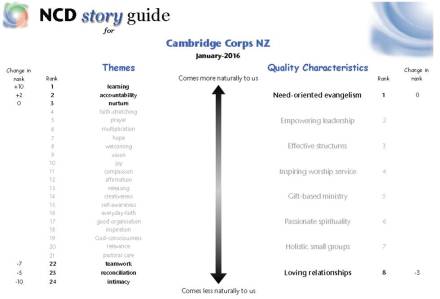
Notice how the results are set out. There is a column with common church Themes and another showing a list of the eight Quality Characteristics, in a different order than we may be accustomed to seeing them. Both of these columns run from strongest to weakest. The bold line in the centre has the caption at the top, ‘Comes more naturally to us,’ and at the bottom, ‘Comes less naturally to us.’

Changing a church culture in order to address weaknesses (read ‘health issues’) is no easy road. Changing oneself is difficult enough, yet that has to be the place where one begins.

There is no suggestion here that NCD is suggesting that we should ‘play to our weaknesses.’ When we think of ‘teams’ and ‘talents’ and ‘spiritual gifts’ each person must play to their strengths. They should focus on those things that ‘come more naturally’ to them; and the same applies to a church. When it comes to character issues, the fruit of the Spirit, or health, we cannot rely on others to compensate for our deficiency.

If the survey result reveals that a church’s strength (something that comes naturally to the church) is Need-oriented Evangelism, and church leaders are somewhat bemused at the lack of newcomers turning up, perhaps a closer look at those things that ‘come less easily to us’ – the Minimum Factors – might just give a clue. As will be very clear, Need-oriented Evangelism is never going to work as it should in the church represented by the diagram above without real attention being given to Loving Relationships. Jesus made that very clear.

Christian Schwarz (Founder and Director of NCD International) has demonstrated the eight Quality Characteristics to be interdependent. If one is weak, without appropriate attention being given to it, it will drag the others down. The church will continue to limp along (like an unhealthy person going about their business) only a fraction of what it could be, not measuring up to what God has in mind for it.

Perhaps church leaders are not committed to the NCD process of becoming healthy; they did a survey out of curiosity and they are finding the changes required to improve church health are just too difficult for them. So they have decided to ignore the survey result and go back to what they were doing before.

If your church fits into this category, let me encourage you to pick it up again; this time, really commit to the process. Follow through. Of course, if you do that you may have to lead the change that is required. As someone once said, “Be the change you want to see.”

Natural Church Development and Process

Allow ‘. . . yourself to win by following the process rather than being caught up in outcomes.’ (‘Legacy,’ What the All Blacks can teach us, p.105, James Kerr). This may have been written about the ‘business’ of life but it applies equally well to the church!

Is this what our church is like?
Do we know what outcomes our church is looking for?
Are we following a clear process to achieve those outcomes?

Natural Church Development says if we have a healthy church, growth (all kinds of growth – people, leaders, financial) will happen automatically – ‘all by itself’ (see the book by Christian Schwarz, ‘The All By Itself Pathway’).
The processes to follow in a church are those that result in a healthy church. That means we need to be aware of four things.

We need to know:
1     What a healthy church looks like (our goal)
2     Our church’s current state of health
3     What we need to do progress from where we are to where we want to be
4     We need to do it!

Number 1 informs us where we want to be, our destination.
Number 2 informs us where we are now. We cannot get anywhere without knowing where we are starting from!
Number 3 gives us the process we should follow to get from #2 to #1.
Number 4 is totally practical; we must follow the process.

The quotation from ‘Legacy’ continues: ‘. . . most organisations . . . tend to go for the one-off hits, which is unrealistic: a training session, an away day, an inspirational speech, but nothing continuous and progressive. Few focus on long-term development, on a programme of improvement.’

Natural Church Development: Overworked Leaders

When pastors and church leaders are asked if they would like to consider ‘doing NCD,’ they often respond they just don’t have the time for anything more. They are already stretched to the limit. ‘One more thing’ may be the last straw for them and their team. Whenever I hear this, I think of the comment made by a school principal:

“This is not ‘one more thing’ we have to do. This is a better way of doing what we already do!”

He was referring to the principle-based approach to education as demonstrated by a school named A.B. Coombs (see the website for videos of some of those schools http://www.TheLeaderInMeBook.org).

These principles were not invented by Christian A Schwarz (Founder and Director of NCD International), Stephen Covey or James Collins or any other human being. They are largely common sense. All cultures have discovered them – and then forgotten them, and either disappeared or deteriorated. They apply to all human institutions, including schools, governments, family and the church.

Identifying and incorporating these principles is the very best way of journeying through life and building something sustainable. We are governed by these principles even when we are unconscious of them or do not even know they exist. They apply to all of life just as the law of gravity affects us physically.

Natural Church Development, the principle-based approach to church life, is happening in your church even as you read this. It can help greatly when church leaders know these principles and actively co-operate with them. What are they? Such things as Empowerment, Gift-activation, Passion, Effectiveness, Inspiration, Community, Need-relief and Love.

The question is: Which one requires your attention in your church or organisation right now? What happens if you neglect that critical issue (think about these questions in terms of your own health)?

What is stopping you from taking steps to identify church health issues right now?

Natural Church Development: The Importance of Regular Checks

Over recent months a number of churches have completed NCD surveys where there has been a 2-6 year gap since the last church health check-up. In each of these health has deteriorated quite markedly.
Perhaps the reason for this can be explained by something Stephen Covey said in his book, ‘First Things First’:
“Much of our pain in life comes from the sense that we are succeeding in one role at the expense of other, possibly more important roles.” (p.82)
If we do not focus intentionally on addressing our Minimum Factor-related issues (and they will be things we find most difficult to engage with) we will drift into working with those aspects of church life we enjoy most, areas that do not presently require so much attention, and we will neglect vital qualities that need to be attended to at this point in our history.

Of course, had those churches completed a church health check-up annually, the downwards drift would have been detected sooner and, hopefully, addressed sooner.

Natural Church Development Principles (Energy Transformation) and the Bible

A wise woman builds her home, but a foolish woman tears it down with her own hands. (Proverbs 14:1 (NLT))

I would suggest the wise woman knows just what she is doing and is intentionally engaged in building her home, while the foolish woman may think she is doing what is right and actually be working against herself.

She cannot understand why everything she does seems to turn out wrong. She does not discern any appreciable difference between herself and the wise woman next door. The only difference she can see is in the outcomes; for her, things are falling apart.

If she is a real fool, and not just someone who is behaving foolishly, she will never be able to trace the disintegration of her family back to her own foolishness. She does not realize that she must begin by working on herself; after that, many other things she has tried so hard to do will begin to fall into place.

That does not mean they will not require effort; they will.

No matter how much she tried before, it seemed impossible to build her home; now she has corrected herself, that which was impossible before now becomes possible with a little effort; or maybe a lot of effort.

The principle of Energy Transformation is at work here. When we look at the Preacher’s comments about what constitutes foolish behavior, together with its Fruitfulness (with the foolish woman, negative, but with the wise woman, positive), we may understand why this woman is tearing her family apart.

This principle applies to both men and women; and it makes no difference what they are engaged in building: a business, a family, a life, a church – we receive back what we put in!

Natural Church Development Principles

Some people might be interested to know just how many New Zealand churches are involved with NCD. I am not being flippant or smart when I respond: 100%. Yes. That’s correct. All New Zealand churches are involved with the principles of Natural Church Development, whether they are aware of it or not. So how can that be?
It is because NCD does not concern itself with programs; if the church is not healthy, programs run by that church will not be healthy either.
Neither does NCD promote the idea of model churches (or programs); the ‘model’ church implies that ‘one size fits all’ when the reality is every church is unique.
The main reason we believe every church (and organisation for that matter) is affected, is that central to the NCD thesis is the idea that everything – including the church – is governed by principles.
Stephen Covey said. ““The principles I am referring to are the basic universal principles that pertain to all human relationships and organisations, for instance fairness, justice, honesty, integrity, trust. They are self-evident, self-validating. These principles are like natural laws that operate regardless of whether we decide to obey them or not. I call them ‘true north’ principles because they don’t shift. They are always there, always reliable, like the ‘true north’ on a compass. And they provide us with rock-solid direction in our lives and in our organisations.
They are also principles that no one argues with. Everyone buys into them. There is a universal common sense about them.” (‘Rethinking the Future,’ Covey, p.36)
That is why we say, no church can avoid being connected with the core of Natural Church Development principles. For these principles are active and affecting everything we do, even if we try to ignore them.

Natural Church Development Principles and the Bible

Choose my instruction rather than silver, and knowledge rather than pure gold. For wisdom is far more valuable than rubies. Nothing you desire can compare with it. (Proverbs 8:10, 11)

My father often used to say to me, “Money does not grow on trees, you know!” It sounded reasonable at the time; but now I’m not so sure.

The Preacher has said we should choose his instruction over silver and gold and rubies. I suppose whenever we buy a book or pay for a course we are more or less doing just that; ‘more or less’ because not all books or all courses would be in the ‘wisdom’ category.

If it comes to a choice between wealth and wisdom, the Preacher says it’s a no brainer; we must choose wisdom.

Now he is making the reason for that clear (Proverbs 8:17-21): Wealth – silver, gold, rubies and other such treasure – is the fruit of wisdom. In other words, if we make worldly wealth our goal, there is no guarantee we will get it; but if we stake our life on finding wisdom we will succeed at finding it, and get wealth thrown in!

By going after money we are pursuing the fruit without nurturing the ‘tree’ that produces the money; that tree is the wisdom the Preacher is talking about.

This whole scenario is very much the way some Christians and churches set up for evangelism; they go after the fruit – converts – without bothering to nurture the plant – their local church – that produces and matures the fruit.

How NCD can help your church: Focus!

Natural Church Development has the potential to Focus your Church

Do you know the number one thing that stops people from getting what they want? It’s lack of focus! Could it be this is also true of churches? With so much to be done, the temptation for a church is to attempt too much. Jesus was focused. Several of His statements would support this. He said, “I will build my church!” Paul was focused. He said, “This one thing I do!” The old comment, “These forty things I dabble in” is, unfortunately, all too true of so many churches. There are many small churches in the world. Not that there is anything wrong with a church being small – unless God wants it bigger! Perhaps they remain small simply because they are attempting to address far more issues than is possible for them to cope with. Natural Church Development can be especially helpful in this regard for the small to middle-sized church. With limited resources—personnel and finance—it is vital that such churches are able to channel those resources where they will make the most difference. By identifying one out of eight primary virtues as a focus, Natural Church Development helps a church attend to the one vital issue at that time in the church’s journey.

“The indispensable first step to getting the things you want out of life is this: decide what you want.” Ben Stein