Natural Church Development Principles and the Bible

My child, listen and be wise: Keep your heart on the right course. Do not carouse with drunkards or feast with gluttons, for they are on their way to poverty, and too much sleep clothes them in rags. Proverbs 23:19-21 (NLT)
What is the Preacher saying here? He is saying, ‘Keep your heart on the right course.’ He has already indicated earlier: Guard your heart above all else, for it determines the course of your life. (Proverbs 4:23). He is suggesting that if we get the heart right, everything else will fall into place.
Let’s take this to the local church. The early church leaders showed little concern for issues that were external to the church. Their chief concern was for problems within the church. Internal problems could do serious damage to the church; problems in the world would have little effect – unless church members opened the door to them. So the Preacher’s advice to his son is equally apt for the church. Let’s keep the heart of the church on the right course. Let’s guard the heart of the church above all else because that determines the course of the church.
What is the heart of the church?
It has to be the leadership team, the main influencers in the church. By surveying the thirty main influencers, we get a picture of the health of the whole church.

If we need to improve the health of our church we do not have to ‘lift’ the total congregation. The focus of our strategy should be, must be, the heart of our church, the leaders, the main influencers; where they go, the rest of the church will follow. What they are, the rest of the church is in the process of becoming.
How Natural Church Development can help your Church: Hearing from God

When we accept the survey result as a snapshot of our church’s current reality (where we are now), we are listening deeply and genuinely to the Holy Spirit of God.

Those who have participated in the survey are the main influencers in the church. Where they go, the church goes. What they model, the church does.

Of all the people in the church, we would expect these people to be influenced by the Spirit of God. Therefore it must follow that the survey result is God’s word for us at this time in our history; just as a doctor’s accurate diagnosis of our health is God’s word for us on that matter.

I once heard a pastor ask if it might be possible for the survey result and the Holy Spirit to be in disagreement with each other. The answer given was informative: “If the Holy Spirit and the survey result do not agree, all I can say is your people are inveterate liars.”

How Natural Church Development can help your Church: Listening to Others

When we accept the survey result as a snapshot of our church’s current reality (where we are now), we are listening deeply and genuinely to 30 influencers in our church.

Listening to, and taking notice of, other member’s view of our church may require a fair amount of personal security. It can uncover our own vulnerabilities. We may need to be changed. And if deep down we are feeling fairly insecure, we cannot afford to risk being changed.

We may be prejudiced about the survey result because it is threatening our cherished and long-held perspective. The result may also be challenging to the area we have always felt so comfortable in. It may be suggesting we should go where we have always resisted going in the past. If we accept the result as a snapshot of our church, we will have to deal with a new thing happening. The specter of change frightens most people (see Principle-Centered Leadership by Stephen Covey, pages 115-116)

What kinds of changes might the survey result require of us?
Head? Logic? Changes in our thinking (The green area of of the 3 colors of Natural Church Development)?
Heart? Emotion? Changes in our feelings (The blue area of NCD)?
Hands? Action? We may have to break out of some habits we have developed over time (The red area of NCD)?

Natural Church Development Principles in the Bible

Those too lazy to plow in the right season will have no food at the harvest. (Proverbs 20:4)

Jesus said He always did what He saw the Father doing in both the spiritual and the natural worlds. In the world of horticulture, believers and unbelievers alike, do what they see the Father doing in the natural world. They know there is a right season to plough, and if they do not plow at that time they will come up short. There will be no food on the table. They are doing what they see the Father doing whether they believe it or not.

Several significant Principles are ignored by a lazy person like this one in Proverbs:

Sowing and reaping, Fruitfulness, Multiplication, Sustainability, Interdependence, Energy Transformation – all of these are working against this lazy person.

Fruitfulness: There will be no fruit because the ground has not been prepared at the right time to receive seed.

For Multiplication to happen, seed has to be sown and a crop harvested.

Unless someone else comes to his rescue, the life of this person will not be Sustained because he has no food.

Because he has failed to work, using the Interdependence that God has set up in His creation, he will starve to death.

This principle will also be working against him.

Energy Transformation: It is very clear that he is investing no energy whatever in doing what needs to be done, when it needs to be done, in the way it needs to be done, so there is zero energy going into the very thing that should be done. Investing energy in avoiding work could very well work against him in his muscles seizing up (what you don’t use, you lose); starvation (scarcity of food); strained relationships (who will continue to provide food and a bed for this sorry individual?)

These are some of the principles that God has woven into His creation and that Natural Church Development is based upon. They are always working whether we acknowledge them or not. And if they are not working for us they will surely be working against us.

How Natural Church Development can help your church: Creating Reality

The survey result reveals the hearts, heads and hands of those surveyed – the influencers in the church.

“. . . our experience-induced perceptions greatly influence our feelings, beliefs, and behaviour.” (page 109, P-CL, Covey).

Let’s do that again: “. . . our experience-induced perceptions greatly influence our feelings (heart – in the 3 colours of Natural Church Development, blue), beliefs (head – green), and behaviour (hands – red).” (page 109, Principle-Centred Leadership, Covey).

In other words, the way we see reality, no matter if the way we see it is the way it is or not, determines how we will respond to it. And our behaviour will change the reality to bring it into line with our perception of it. Think about it: If we see the church a certain way, if the way we see it is wrong, if we keep on seeing it that way, eventually it will become the way we see it. It’s important to see it how it is. And it’s very important to see it as it should be, and as it could become.

How Natural Church Development can help your church: The Church is More than Me!

Sometimes – perhaps often – the survey result is difficult to accept.

This is mainly because each person involved thinks they see the ‘world (substitute, ‘church’)’ as it is rather than seeing everything as they are. Unaware of the glasses he or she is wearing, with the subsequent distortion in his or her own perception and the attitude is: ‘If you disagree with me, in my eyes you (the collated survey result) are automatically wrong, simply because I am sure that I am right.’ (“Principle-Centered Leadership.” 109, Stephen Covey,)

Example: Jesus said something about the way we see things:

“Why do you look at the speck of sawdust in your brother’s eye and pay no attention to the plank in your own eye? How can you say to your brother, ‘Let me take the speck out of your eye,’ when all the time there is a plank in your own eye? You hypocrite, first take the plank out of your own eye, and then you will see clearly to remove the speck from your brother’s eye. (Matthew 7:3-5, NIV)

Natural Church Development Principles in the Bible

A fool’s proud talk becomes a rod that beats him, but the words of the wise keep them safe. (Proverbs 14:3)

Why such different outcomes over mere words? Words are much more than words. They are pronouncements that are supported by the nature of the person who utters them. They are extensions of his character. The words of the wise are spoken with integrity; that is, the words of the wise are aligned with their thoughts and emotions and their actions. They are holistic. The proud talk of fools has very little connection with reality. The fool’s pride prevents him from seeing life as it really is. Instead, he sees life as he is and, in his eyes, he is larger than life. Proud talk has very little to do with what the fool is able to achieve; he promises much but delivers less.

The tragedy of all this is the fool does not seem able to understand the Energy Transformation principle that is working against him here. He cannot for the life of him see how his ‘proud talk’ has morphed into a ‘rod that beats him.’

How Natural Church Development can help your church: Reality

  • The survey reveals, not reality as it is, but reality as the respondents see it.

These are some of the questions from the NCD survey questionnaire:

Q. There is a lot of joy and laughter in our church.

Q. The atmosphere of our church is strongly influenced by praise and compliments.

Q. Our leaders clearly believe that God wants our church to grow.

Q. I feel that the worship service has a positive influence on me.

Q. It is my impression that the organizational structure of our church hinders church life rather than promotes it.

Q. I always look forward to the worship service.

Q. I can easily explain why I come to the worship service.

Q. Many people are given the opportunity to actively participate in our worship services.

Q. The music in the worship service helps me worship God.

Q. There is a lot of creativity in the evangelistic activities of our church.

Covey says, ‘None of us sees the world as it is but as we are, as our frame of reference defines the territory. ‘ (page 109, Principle-Centered Leadership).

God knows this. That’s how He made us. That’s why David wrote: “To the faithful you how yourself faithful; to those with integrity you show integrity. To the pure you show yourself pure, but to the wicked you show yourself hostile. You rescue the humble, but you humiliate the proud. (Psalm 18:25-27 NLT)

So the survey result is a revelation of the people who answer the questions and consequently, a revelation of their church.

The fact of the matter is, for us, our perception is the reality. That’s why we need thirty people (who meet certain criteria) to complete the survey. We want the combined perspective of a group rather than the ‘reality’ of just one person!

How NCD can help your church: Balance

Natural Church Development has the potential to help a church become more balanced in its ministry:

Is balance all that important? And if it is, why?

Image

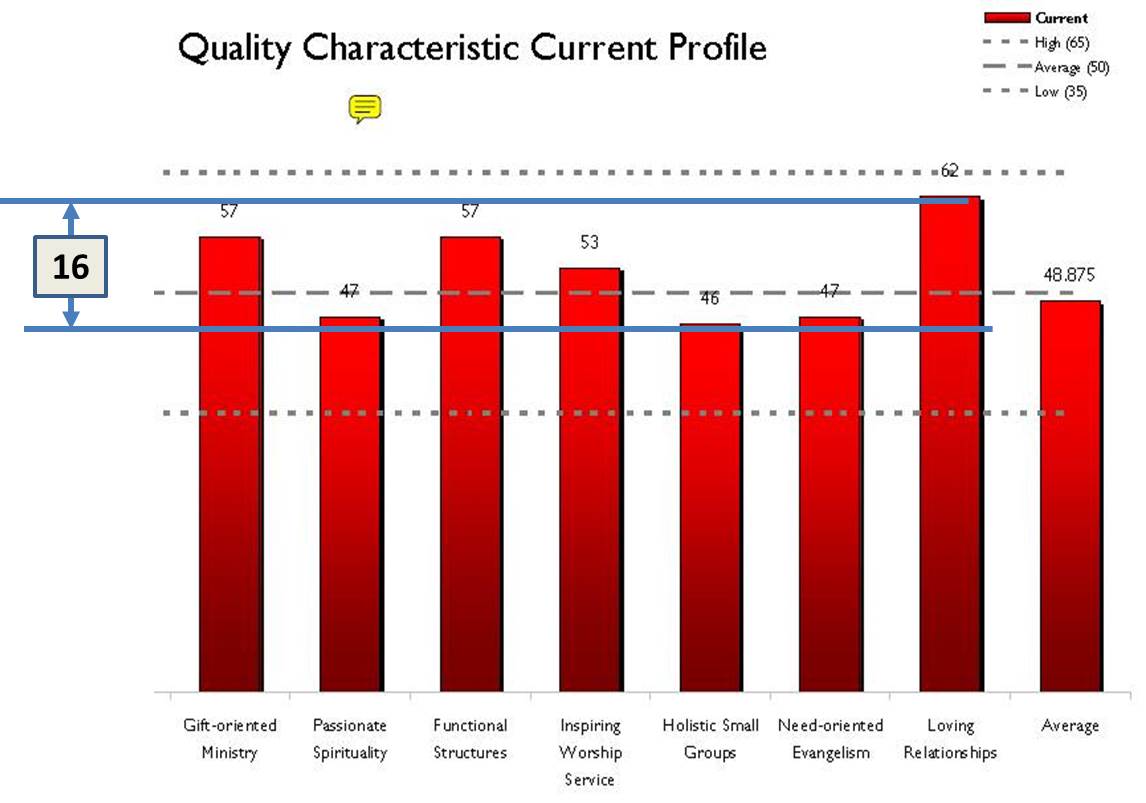
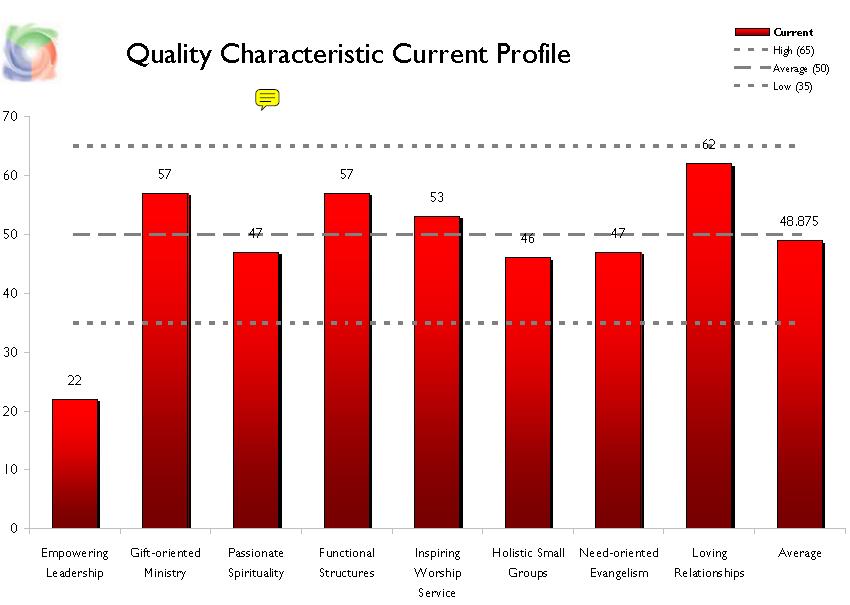
This church appears to be very well balanced – only 16 (Min-Max difference) between the Minimum Factor (Holistic Small Groups: 46) and the strongest Quality Characteristic (Loving Relationships at 62). And it would be well balanced except that I have omitted the real Minimum Factor – Empowering Leadership at 22 (see below). This makes a Min-Max difference of 40 – not healthy at all.

Image

Even so, this Profile is good news. It tells us exactly where to concentrate in order to make this church’s health more balanced. This church is being held back quite dramatically by one Quality Characteristic. If they could just get improve ‘Empowerment,’ church health has the potential to go through the roof!

Whether considering humans or churches, an important requirement for health is balance. To be healthy one needs to be balanced. Living creatures find it difficult, if not impossible, to reproduce when health is out of balance.

Balance does not mean ‘rigid.’ Balance means being flexible enough to compensate for whatever is happening at the moment. A tightrope walker needs balance, but is constantly compensating for the wind, rope tension, and personal movement and so on.

When we do a survey the profile tells us where to adjust in order to achieve balance. The next survey informs us where we need to adjust now.

Not only does Natural Church Development help us become balanced, it also points out the need for flexibility. It reminds us that no two churches are the same, and that we are not the same church we were when we did our last survey. An absence of balance creates sick churches.

The gap between the Minimum Factor and the Maximum Factor (the Min-Max Difference) of the Quality Characteristics in any church is critical. A standard deviation of Natural Church Development = 15. Church health is more sustainable situation where that gap is small – 15 or less.

When the gap is large (e.g., a score of 30 is 2 standard deviations), and if that church does not give attention to it’s Minimum Factor and improve its health, then the Maximum Factor will be dragged down and the health of that corps will collapse. Perhaps this sheds light on why so many churches have seemed poised on a breakthrough, yet never quite make it to the next level.

Could it be that the Quality Characteristics of Natural Church Development actually define true revival?

Do revivals cease because they eventually become unbalanced and begin to emphasize aspects of church life but neglect other key components that would keep the movement balanced and healthy?

How NCD can help your church: Principles

Natural Church Development has the potential to take a church from copying ‘Model’ churches to co-operating with God’s unchanging and unchangeable principles: 

When we look at another church as a ‘model’ we imitate what they are doing (This may be fine; and it may also be like taking someone else’s prescription medicine!). But with principles we can look at different churches from any location on the planet. We abstract those things that work in any culture and in any place: Principles. We ignore the local characteristics and flavour….the practices. We know that the principles have application to all other churches in general and to our specific church situation in particular. The Principles inform us “How” the Natural Church Development process should be engaged. 

One of the goals of Natural Church Development is to have pastors and people think principle.

 Christian Schwarz defines what is meant by ‘principle.’

  • Principles are universally valid. They apply to all denominations, to all church models, to all devotional styles, and to all cultures.
  • Principles must be proven. Some so-called principles are more properly ‘interesting concepts that are worth considering.’ The only way to know if something is a principle is to find out if it works in all cultures and settings.
  • Principles always deal with what is essential. Principles do not deal with cosmetic issues or secondary aspects of the Christian life. Therefore we may expect to find these principles also described in the Bible, even if we use different language and terms.
  • Principles always have to be individualized. They never tell you exactly what to do. Rather, they give you criteria which can help you discover what should be done in a given situation.

“Basing our happiness on our ability to control everything is futile. While we do control our choice of action, we cannot control the consequences of our choices. Universal laws or principles do. Thus, we are not in control of our lives; principles are. We live in a modern society that loves shortcut techniques. Yet quality of life cannot be achieved by taking the right shortcut. There is no shortcut. But there is a path. The path is based on principles revered throughout history. If there is one message to glean from this wisdom, it is that a meaningful life is not a matter of speed or efficiency. It’s much more a matter of what you do and why you do it, than how fast you get it done.” (Stephen Covey, ‘First Things First”)