Ignoring the Principles?

God detests the prayers of a person who ignores the law. (Proverbs 28:9 (NLT))

Which law is the Preacher referring to? Is it the law that governs all of creation, the law that God has woven into everything He has made, the principles that Christian Schwarz and Stephen Covey and Andy Stanley – and many others – write about? Principles that are unchanging and unchangeable and self-evident (when you really think about them)?

God detests such prayers because they are prayers He cannot answer the way the pray-ers are wanting Him to answer. Such requests are like a person who sows carrot seed in the garden, and then prays that God will cause parsnips to grow!

What can God do with a prayer like that?

Does this have anything to say about giving thanks before eating food we like rather than food that is good for us?

The whole idea here is that we are praying to God for things that, if He were to answer by approving our requests, would cause the whole creation to fall apart; prayers that God simply cannot answer, prayers He detests because if He were to answer the way we want Him to, He would be denying Himself, acting in opposition to His own nature.

Are some of our prayers for evangelism and church growth like that, that is to say, God cannot answer them because He would be denying His character?

What do you think?

What is Reality?

The wife of a missionary couple serving in PNG became ill and was treated for malaria – given quinine. She did not respond to the treatment as expected and was taken to a clinic where the medical resources were somewhat better than the local situation. It was discovered she was suffering from bronchitis! She did not have malaria – which she was being treated for – and the quinine was slowly killing her. It was the wrong treatment for what was ailing her. Could it be this is happening in some of our churches? They are being treated for an illness which they do not have; the treatment is not improving them and, in some cases is making them even sicker. We need to be sure the measures we are taking to improve our churches are the measures they really do need at this point in their life.

If you have been lost in an unfamiliar city (without a map or a GPS), but have managed to make phone contact with one who knows their way round, they will always ask one question: ‘Where are you now?’ Until they know where we are, they cannot tell us how to get where we want to go.

One of the axioms Bill Hybels advocates is Facts are your Friends. In his book, Axiom, he tells about a pastor who didn’t like the ‘facts’ and, partway through a planning session, asked Bill to leave. Jim Collins (Good to Great) discovered that a characteristic of leaders who took their companies from Good to Great was they faced the truth. He says, “All good-to-great companies began the process of finding a path to greatness by confronting the brutal facts of their current reality.” Max DePree said the task of a leader is to define reality. Whatever field we are operating in, we need to know exactly where we are before we can get to where we want to go.

The Natural Church Development church heath assessment can help church leaders discover the facts of their current reality in order to know where they are starting from.

If you want to know more about Natural Church Development please contact me.

NCD: A Common Denominator

There was a time when going to church was a bit like going to MacDonald’s; that is, you could predict what the experience would be like.

Not anymore.

Very few churches are the same today, even when they are from the same denomination (stream) and have the same label.

One reason for this is that church hierarchy have encouraged their pastors to shape the local church to fit the community where that church is located. The idea seems to make sense, but there is one very large hitch. Pastors, like all human beings, do not come without bias. They are not able to shape anything without putting their own personal stamp on it. Even our perception of God is biased! When a pastor seeks to fit the church to the community, (s)he also unintentionally (or intentionally) shapes the church to fit him- or her-self.

Another reason the worship experience from church to church is so different these days, could be that many of them have removed denominational labels and named themselves simply ‘Anytown’ Community Church.

Local churches are becoming more individualistic (the truth is, like siblings, they always have been different – unique – even when they looked similar), looking different from one another. Comparing churches these days is like comparing apples and oranges; they appear to be so different.

Is there any way we can find common ground between churches that appear so different?

Yes, there is a way.

A church leader I know who had responsibility for the oversight of some twenty churches in his denomination, decided to invite them all to complete a Natural Church Development church health assessment. The great value for him was that in each church’s regular review he now had a measure that was common to them all no matter the size of the church; no matter how many (or how few) programs the church was running; no matter what leaders and/or pastors said about their church; no matter what kind of worship team, or music (even untuneful – make a joyful noise) or other components of the worship experience.

Natural Church Development (NCD) takes us to bedrock, to what is essential in any church.

·       Empowering Leadership

·       Gift-based Ministry

·       Passionate Spirituality

·       Effective Structures

·       Inspiring Worship Service

·       Holistic Small Groups

·       Need-oriented Evangelism

·       Loving Relationships

These are like the vital organs of a human being; it is difficult to go on living if someone removes one of our vital organs. And a group could scarcely be a church if any one of these is missing.

The good news for our leader who asked his church to complete the health assessment was they all registered a score in all eight qualities. The not so good news was that some were quite low. But that’s another story.

Natural Church Development Principles: Symbiosis

The Preacher says: “Pride leads to disgrace, but with humility comes wisdom.” (Proverbs 11:2 NLT)

The ancient Greeks believed this, and so did the Preacher. Stephen Covey says that pride is the great barrier to Synergy or symbiosis. He gives this example: “The synergy mentality short-circuits conflict in the workplace, and the resulting spark of genius can be dazzling. But synergy does not come cheap, and the forces working against it are formidable. The toughest barrier to synergy is pride. It’s the great insulator that prevents the creative blending of human energies.

There is a whole continuum of pride, from the familiar “NIH Syndrome” (“If it’s Not Invented Here, it can’t be worth anything”) all the way to the hubris that leads to the downfall of people, organizations, and nations.

The ancient Greeks taught that hubris, or extreme arrogance, was the worst of crimes. In those days, a soldier who boasted of his own strength and humiliated his enemies was guilty of hubris. So was a king who abused his subjects for his personal gain. The Greeks believed that hubris would bring on nemesis, or inevitable ruin. Hubris, they said, always leads to tragedy in the end—and they were right.

Today we’ve seen the collapse of some of our most trusted institutions because of hubris at the highest levels. In the financial debacle of 2008, many key leaders were guilty of everything from blind overconfidence to outright fraud.

The main symptom of hubris is a lack of conflict. If no one dares to challenge you, if you receive little input from others, if you find yourself talking more than listening, if you’re too busy to deal with those who disagree then you’re heading for a fall. An example is the former head of the Royal Bank of Scotland.

According to reports, this man “brooked no criticism. . . . Every morning his immediate circle took part in a meeting where on occasions executives could he reprimanded seriously.” He referred to his unfriendly acquisitions as mercy killings. The Times of London called his leadership “hubristic.” Thus he was isolated from the truth about the oncoming banking crisis, for which his aggressively risky business dealings were said to be partly responsible

In 2007 his bank was worth £75 billion; by 2009 it was worth £4.5 billion and had suffered “the biggest loss in British banking history.”’

Looking at another example, it’s probable that the anti-synergy mind-set at Enron brought that company down. Observers see in Enron the classic model of a hubristic culture: “This was a company that purposely shut down alternative and conflicting views of reality to protect the status quo. In the name of preserving success and being in hard-nosed pursuit of greatness, an inflexible, intolerant culture developed in which new ideas were ignored, concerns were dismissed, and critical thinking got you fired.” (Covey, ‘The 3rd Alternative’)

The Preacher was so convinced of the folly of pride that he states categorically that it leads to disgrace, period. And he states it publicly as an axiom, a life principle, as though there is no escaping the disgrace that pride will bring in the end. Pride makes us think we’re better than we are. Pride prevents us from listening to the opinions of others as being valid perspectives in any given situation. Pride makes us think we know best. Pride prevents us from understanding that we, too, have blind spots, and that we need others to help us understand the whole picture.

The NCD Process: Commitment

Why do church leaders do one or two or even more church health surveys, and then quit?

Why do they not commit to the process, and follow through to becoming a healthy church?

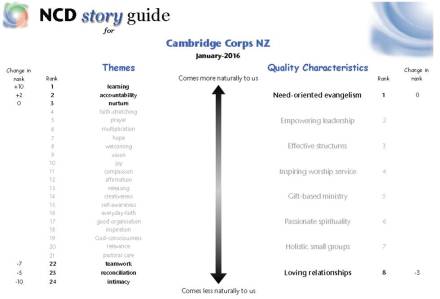
Perhaps the answer is hinted at, in part, in the front page of the NCD Story Guide (see picture):Story Guide

Notice how the results are set out. There is a column with common church Themes and another showing a list of the eight Quality Characteristics, in a different order than we may be accustomed to seeing them. Both of these columns run from strongest to weakest. The bold line in the centre has the caption at the top, ‘Comes more naturally to us,’ and at the bottom, ‘Comes less naturally to us.’

Changing a church culture in order to address weaknesses (read ‘health issues’) is no easy road. Changing oneself is difficult enough, yet that has to be the place where one begins.

There is no suggestion here that NCD is suggesting that we should ‘play to our weaknesses.’ When we think of ‘teams’ and ‘talents’ and ‘spiritual gifts’ each person must play to their strengths. They should focus on those things that ‘come more naturally’ to them; and the same applies to a church. When it comes to character issues, the fruit of the Spirit, or health, we cannot rely on others to compensate for our deficiency.

If the survey result reveals that a church’s strength (something that comes naturally to the church) is Need-oriented Evangelism, and church leaders are somewhat bemused at the lack of newcomers turning up, perhaps a closer look at those things that ‘come less easily to us’ – the Minimum Factors – might just give a clue. As will be very clear, Need-oriented Evangelism is never going to work as it should in the church represented by the diagram above without real attention being given to Loving Relationships. Jesus made that very clear.

Christian Schwarz (Founder and Director of NCD International) has demonstrated the eight Quality Characteristics to be interdependent. If one is weak, without appropriate attention being given to it, it will drag the others down. The church will continue to limp along (like an unhealthy person going about their business) only a fraction of what it could be, not measuring up to what God has in mind for it.

Perhaps church leaders are not committed to the NCD process of becoming healthy; they did a survey out of curiosity and they are finding the changes required to improve church health are just too difficult for them. So they have decided to ignore the survey result and go back to what they were doing before.

If your church fits into this category, let me encourage you to pick it up again; this time, really commit to the process. Follow through. Of course, if you do that you may have to lead the change that is required. As someone once said, “Be the change you want to see.”

Natural Church Development and Principles

In his Empowerment Diary, entry #127, Christian Schwarz (Founder and Director of NCD International) said: “Today I had an interesting discussion about the question of why we focus so consistently (the person I spoke to called it, “fanatically”) on principles throughout all of our NCD tools (the criticism was, “Not practical enough!”).

The answer is simple:

Principles are valid whether you believe in them or not. They will influence your life, even if you should decide to reject them. They apply regardless of your theological bent, your philosophy of ministry, or your favourite church model. And they even apply should you decide not to utilize them. In other words, whenever we are dealing with provable principles (rather than mere models or inspirational examples), we are on solid ground. Once we have identified the principles (which in our case works in a blend of empirical research and biblical/theological evaluation), the second step is to apply them to complex realities of an individual church – the core of any Mutual Empowerment Process.”

Stephen Covey (7 Habits) says: “I do not agree with the popular success literature that says self-esteem is primarily a matter of mind-set, of attitude – that you can psyche yourself into peace of mind. Peace of mind comes when your life is in harmony with true principles and values and in no other way.”

One such principle (and how they work) is referred to in a paper published at Harvard Business School where Michael C. Jensen, Werner Erhard and Steve Saffron explore the relationship between integrity and performance. Of integrity, they say: “Like the law of gravity, the law (principle) of integrity just is, and if you violate the law of integrity . . . you get hurt just as if you try to violate the law of gravity with no safety device.” (‘Legacy’ James Kerr, page 127)

Integrity is one of the principles that is unchanging and unchangeable. No one can ignore or ‘break’ the integrity principle without being seriously damaged themselves.

And integrity is just one of them!

People may accomplish remarkable things while ignoring these principles, but their work will prove unsustainable in the long run.

Natural Church Development and “Legacy”

This is an appropriate time to recommend a book: “Legacy” by James Kerr. Subtitled, What the All Blacks can teach us about the business of life. It’s an appropriate time because we are in the middle of the 2015 World Rugby Cup in England, and the All Blacks are about to play a quarterfinal against France this coming weekend.
Let me select a very few choice pieces:
After the game, while the country is still watching replays and schoolkids lie in bed dreaming of All Black glory, the senior All Blacks are tidying up after themselves. They have had the debrief; now they have picked up brooms and are sweeping the shed. Doing it properly. They have a servant spirit.
Character before Talent:
Wayne Smith (one of the coaches) said: “Talent was irrelevant.” We used certain game stats that determine the player’s character, and that’s what we were after. We picked high work rate, guys that were unselfish and had a sacrificial mindset. It is the identity of the team that matters – not so much what the All Blacks do, but who they are, what they stand for, and why they exist.
Leadership and Empowerment:
The All Blacks have developed a leadership culture. The structure of the working week: The Sunday evening review meetings are facilitated by the coaches, thought significant input comes from the on-field leadership. Then over the course of the week, you see a gradual handing over of responsibility and decision-making. By Thursday, the priorities, intensity levels and other aspects are all ‘owned’ by the players. By the time they play on Saturday the players have taken over the asylum. Graham Henry (head coach at the time) says that enabling his players to take charge of their own environment is, of all his achievements in rugby, the thing of which he is most proud.
What would the church look like if pastors operated this way?
If you are able to make the connection, this is a great book on discipleship and leadership. It fits very well into the principles of Natural Church Development. I do not hesitate to recommend it.

Natural Church Development: Overworked Leaders

When pastors and church leaders are asked if they would like to consider ‘doing NCD,’ they often respond they just don’t have the time for anything more. They are already stretched to the limit. ‘One more thing’ may be the last straw for them and their team. Whenever I hear this, I think of the comment made by a school principal:

“This is not ‘one more thing’ we have to do. This is a better way of doing what we already do!”

He was referring to the principle-based approach to education as demonstrated by a school named A.B. Coombs (see the website for videos of some of those schools http://www.TheLeaderInMeBook.org).

These principles were not invented by Christian A Schwarz (Founder and Director of NCD International), Stephen Covey or James Collins or any other human being. They are largely common sense. All cultures have discovered them – and then forgotten them, and either disappeared or deteriorated. They apply to all human institutions, including schools, governments, family and the church.

Identifying and incorporating these principles is the very best way of journeying through life and building something sustainable. We are governed by these principles even when we are unconscious of them or do not even know they exist. They apply to all of life just as the law of gravity affects us physically.

Natural Church Development, the principle-based approach to church life, is happening in your church even as you read this. It can help greatly when church leaders know these principles and actively co-operate with them. What are they? Such things as Empowerment, Gift-activation, Passion, Effectiveness, Inspiration, Community, Need-relief and Love.

The question is: Which one requires your attention in your church or organisation right now? What happens if you neglect that critical issue (think about these questions in terms of your own health)?

What is stopping you from taking steps to identify church health issues right now?

Natural Church Development Principles (Energy Transformation) and the Bible

A wise woman builds her home, but a foolish woman tears it down with her own hands. (Proverbs 14:1 (NLT))

I would suggest the wise woman knows just what she is doing and is intentionally engaged in building her home, while the foolish woman may think she is doing what is right and actually be working against herself.

She cannot understand why everything she does seems to turn out wrong. She does not discern any appreciable difference between herself and the wise woman next door. The only difference she can see is in the outcomes; for her, things are falling apart.

If she is a real fool, and not just someone who is behaving foolishly, she will never be able to trace the disintegration of her family back to her own foolishness. She does not realize that she must begin by working on herself; after that, many other things she has tried so hard to do will begin to fall into place.

That does not mean they will not require effort; they will.

No matter how much she tried before, it seemed impossible to build her home; now she has corrected herself, that which was impossible before now becomes possible with a little effort; or maybe a lot of effort.

The principle of Energy Transformation is at work here. When we look at the Preacher’s comments about what constitutes foolish behavior, together with its Fruitfulness (with the foolish woman, negative, but with the wise woman, positive), we may understand why this woman is tearing her family apart.

This principle applies to both men and women; and it makes no difference what they are engaged in building: a business, a family, a life, a church – we receive back what we put in!

Natural Church Development Principles

Some people might be interested to know just how many New Zealand churches are involved with NCD. I am not being flippant or smart when I respond: 100%. Yes. That’s correct. All New Zealand churches are involved with the principles of Natural Church Development, whether they are aware of it or not. So how can that be?
It is because NCD does not concern itself with programs; if the church is not healthy, programs run by that church will not be healthy either.
Neither does NCD promote the idea of model churches (or programs); the ‘model’ church implies that ‘one size fits all’ when the reality is every church is unique.
The main reason we believe every church (and organisation for that matter) is affected, is that central to the NCD thesis is the idea that everything – including the church – is governed by principles.
Stephen Covey said. ““The principles I am referring to are the basic universal principles that pertain to all human relationships and organisations, for instance fairness, justice, honesty, integrity, trust. They are self-evident, self-validating. These principles are like natural laws that operate regardless of whether we decide to obey them or not. I call them ‘true north’ principles because they don’t shift. They are always there, always reliable, like the ‘true north’ on a compass. And they provide us with rock-solid direction in our lives and in our organisations.
They are also principles that no one argues with. Everyone buys into them. There is a universal common sense about them.” (‘Rethinking the Future,’ Covey, p.36)
That is why we say, no church can avoid being connected with the core of Natural Church Development principles. For these principles are active and affecting everything we do, even if we try to ignore them.