Natural Church Development Principles: Symbiosis

The Preacher says: “Pride leads to disgrace, but with humility comes wisdom.” (Proverbs 11:2 NLT)

The ancient Greeks believed this, and so did the Preacher. Stephen Covey says that pride is the great barrier to Synergy or symbiosis. He gives this example: “The synergy mentality short-circuits conflict in the workplace, and the resulting spark of genius can be dazzling. But synergy does not come cheap, and the forces working against it are formidable. The toughest barrier to synergy is pride. It’s the great insulator that prevents the creative blending of human energies.

There is a whole continuum of pride, from the familiar “NIH Syndrome” (“If it’s Not Invented Here, it can’t be worth anything”) all the way to the hubris that leads to the downfall of people, organizations, and nations.

The ancient Greeks taught that hubris, or extreme arrogance, was the worst of crimes. In those days, a soldier who boasted of his own strength and humiliated his enemies was guilty of hubris. So was a king who abused his subjects for his personal gain. The Greeks believed that hubris would bring on nemesis, or inevitable ruin. Hubris, they said, always leads to tragedy in the end—and they were right.

Today we’ve seen the collapse of some of our most trusted institutions because of hubris at the highest levels. In the financial debacle of 2008, many key leaders were guilty of everything from blind overconfidence to outright fraud.

The main symptom of hubris is a lack of conflict. If no one dares to challenge you, if you receive little input from others, if you find yourself talking more than listening, if you’re too busy to deal with those who disagree then you’re heading for a fall. An example is the former head of the Royal Bank of Scotland.

According to reports, this man “brooked no criticism. . . . Every morning his immediate circle took part in a meeting where on occasions executives could he reprimanded seriously.” He referred to his unfriendly acquisitions as mercy killings. The Times of London called his leadership “hubristic.” Thus he was isolated from the truth about the oncoming banking crisis, for which his aggressively risky business dealings were said to be partly responsible

In 2007 his bank was worth £75 billion; by 2009 it was worth £4.5 billion and had suffered “the biggest loss in British banking history.”’

Looking at another example, it’s probable that the anti-synergy mind-set at Enron brought that company down. Observers see in Enron the classic model of a hubristic culture: “This was a company that purposely shut down alternative and conflicting views of reality to protect the status quo. In the name of preserving success and being in hard-nosed pursuit of greatness, an inflexible, intolerant culture developed in which new ideas were ignored, concerns were dismissed, and critical thinking got you fired.” (Covey, ‘The 3rd Alternative’)

The Preacher was so convinced of the folly of pride that he states categorically that it leads to disgrace, period. And he states it publicly as an axiom, a life principle, as though there is no escaping the disgrace that pride will bring in the end. Pride makes us think we’re better than we are. Pride prevents us from listening to the opinions of others as being valid perspectives in any given situation. Pride makes us think we know best. Pride prevents us from understanding that we, too, have blind spots, and that we need others to help us understand the whole picture.

Change and Natural Church Development

The church is just over twenty years old. It’s a suburban church. It was planted with the intention of providing a worship experience that would appeal to the unchurched of the suburb. One might suppose that would be the purpose of every church, but that doesn’t seem to be the case.

The pastors – a married couple – and their team worked well together. The church was established and built around the gifting of the pastors. It reached a peak attendance of just over 250 in the Sunday morning service.

Since the founding pastors moved on eight years ago, there have been three changes of pastor couples (with another taking up the challenge early 2017).

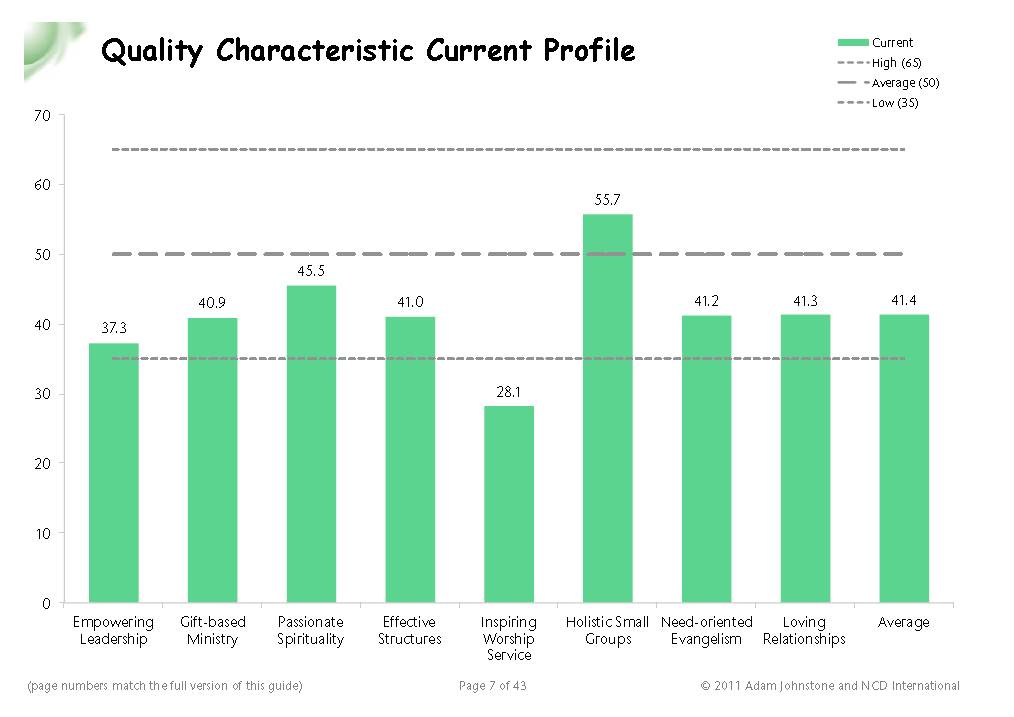
The last two sets of pastor were there for three years each – the last six years. And it was six years ago the church decided to engage with the Natural Church Development health assessment. They were somewhat disappointed to get this result:

Taken by itself, this is an encouraging result. But this church and the pastors were disappointed. They were especially disappointed because the church had a reputation for great worship. They were also disappointed because the pastor’s previous church had been healthier.

Five years, five surveys and a change of pastors, and all their efforts, and not much else has changed (although the level of frustration has risen!).

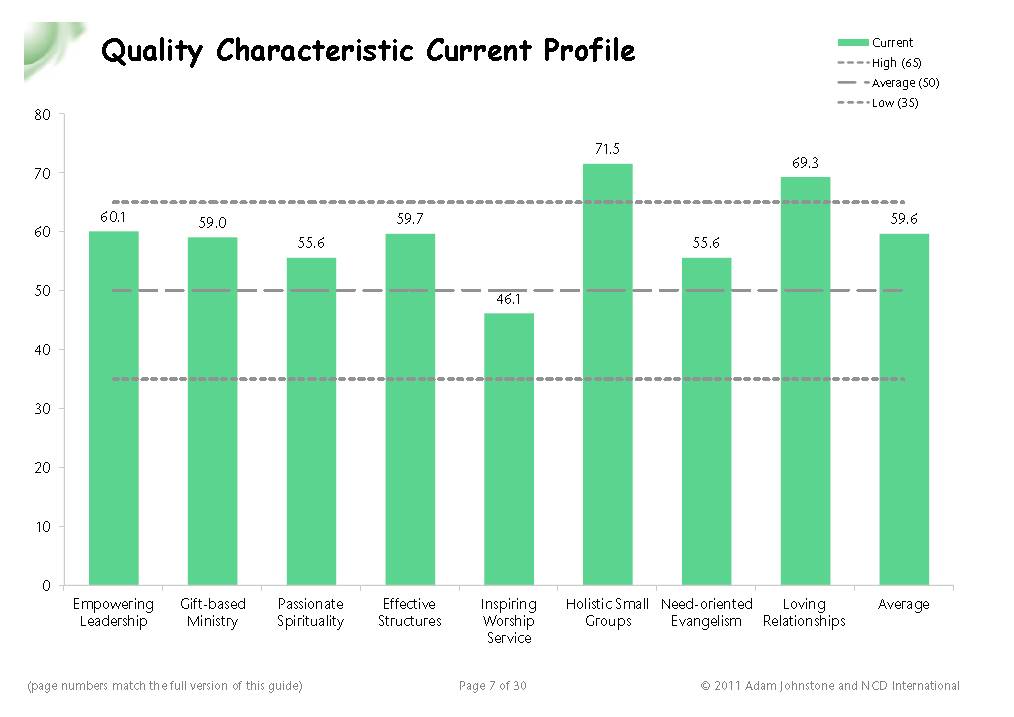
All six surveys have shown the same pattern – Minimum Factor: Inspiring Worship Service. Maximum Factor: Holistic Small Groups. Visitors to this church love the worship; why have the most influential lay people responded to the NCD health test so that it consistently showed this result?

At the beginning this church demonstrated so much promise.

What might be the trouble?

How Natural Church Development can help your church: Creating Reality

The survey result reveals the hearts, heads and hands of those surveyed – the influencers in the church.

“. . . our experience-induced perceptions greatly influence our feelings, beliefs, and behaviour.” (page 109, P-CL, Covey).

Let’s do that again: “. . . our experience-induced perceptions greatly influence our feelings (heart – in the 3 colours of Natural Church Development, blue), beliefs (head – green), and behaviour (hands – red).” (page 109, Principle-Centred Leadership, Covey).

In other words, the way we see reality, no matter if the way we see it is the way it is or not, determines how we will respond to it. And our behaviour will change the reality to bring it into line with our perception of it. Think about it: If we see the church a certain way, if the way we see it is wrong, if we keep on seeing it that way, eventually it will become the way we see it. It’s important to see it how it is. And it’s very important to see it as it should be, and as it could become.

How Natural Church Development can help your church: The Church is More than Me!

Sometimes – perhaps often – the survey result is difficult to accept.

This is mainly because each person involved thinks they see the ‘world (substitute, ‘church’)’ as it is rather than seeing everything as they are. Unaware of the glasses he or she is wearing, with the subsequent distortion in his or her own perception and the attitude is: ‘If you disagree with me, in my eyes you (the collated survey result) are automatically wrong, simply because I am sure that I am right.’ (“Principle-Centered Leadership.” 109, Stephen Covey,)

Example: Jesus said something about the way we see things:

“Why do you look at the speck of sawdust in your brother’s eye and pay no attention to the plank in your own eye? How can you say to your brother, ‘Let me take the speck out of your eye,’ when all the time there is a plank in your own eye? You hypocrite, first take the plank out of your own eye, and then you will see clearly to remove the speck from your brother’s eye. (Matthew 7:3-5, NIV)

How Natural Church Development can help your church: Reality

  • The survey reveals, not reality as it is, but reality as the respondents see it.

These are some of the questions from the NCD survey questionnaire:

Q. There is a lot of joy and laughter in our church.

Q. The atmosphere of our church is strongly influenced by praise and compliments.

Q. Our leaders clearly believe that God wants our church to grow.

Q. I feel that the worship service has a positive influence on me.

Q. It is my impression that the organizational structure of our church hinders church life rather than promotes it.

Q. I always look forward to the worship service.

Q. I can easily explain why I come to the worship service.

Q. Many people are given the opportunity to actively participate in our worship services.

Q. The music in the worship service helps me worship God.

Q. There is a lot of creativity in the evangelistic activities of our church.

Covey says, ‘None of us sees the world as it is but as we are, as our frame of reference defines the territory. ‘ (page 109, Principle-Centered Leadership).

God knows this. That’s how He made us. That’s why David wrote: “To the faithful you how yourself faithful; to those with integrity you show integrity. To the pure you show yourself pure, but to the wicked you show yourself hostile. You rescue the humble, but you humiliate the proud. (Psalm 18:25-27 NLT)

So the survey result is a revelation of the people who answer the questions and consequently, a revelation of their church.

The fact of the matter is, for us, our perception is the reality. That’s why we need thirty people (who meet certain criteria) to complete the survey. We want the combined perspective of a group rather than the ‘reality’ of just one person!

How the NCD Survey can help your church: Reality

The Natural Church Development survey reveals, not reality as it is, but reality as the respondents see it.

These are some of the questions from the participants questionnaire: 1. There is a lot of joy and laughter in our church. 2. The atmosphere of our church is strongly influenced by praise and compliments. 3. Our leaders clearly believe that God wants our church to grow. 4. I feel that the worship service has a positive influence on me. 5. It is my impression that the organizational structure of our church hinders church life rather than promotes it. 6. I always look forward to the worship service. 6. I can easily explain why I come to the worship service. 7. Many people are given the opportunity to actively participate in our worship services. 8. The music in the worship service helps me worship God. 9. There is a lot of creativity in the evangelistic activities of our church.

Stephen Covey says, ‘None of us sees the world as it is but as we are, as our frame of reference defines the territory. ‘God knows this. That’s how He made us. That’s why David wrote: “To the faithful you how yourself faithful; to those with integrity you show integrity. To the pure you show yourself pure, but to the wicked you show yourself hostile. You rescue the humble, but you humiliate the proud. (Psalm 18:25-27 NLT)

So the survey result is a revelation of the people who answer the questions and consequently, a revelation of their church. The fact of the matter is, for us, our perception is the reality. That’s why we need thirty people to do the survey. We want the combined perspective of a group rather than just one person’s ‘reality’!